What does a flock of birds have to do with safety culture?
Building Organisational Readiness Alongside Technology
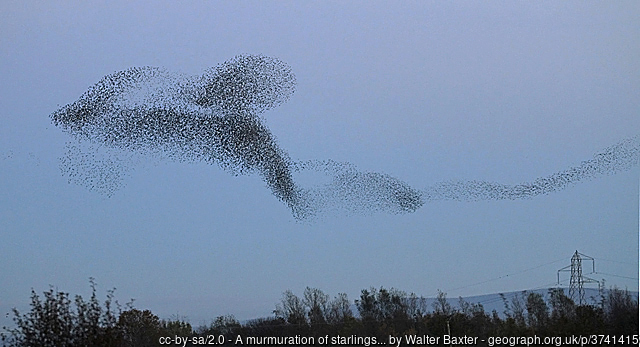
The British mathematician Hannah Fry has an engaging way of making complexity understandable to a broad audience. To illustrate how coherent system-level behaviour can emerge from interaction, she uses the example of a flock of birds moving in remarkable coordination without any central controller. This collective behaviour arises from simple local “rules” and repeated interactions: each bird responds to those nearby, adjusts its movement and, in doing so, continuously reshapes the whole.
Similar forms of emergence can be seen both in nature and in human societies.
Rather than simply the absence of unwanted events, safety emerges from how the different elements of the system interact, adapt and respond as the system evolves: it is not produced by any single component or actor alone, but arises from how human, technology and organization and other contextual factors work together, adapt and respond to changing conditions over time.
In a similar way, rather than something an organisation simply has or can directly implement, safety culture can be understood as an ongoing social process through which people develop shared assumptions and learn, over time, what it means to prioritise safety in practice: what deserves attention, how uncertainty is interpreted, whose knowledge is heard, what is regarded as normal, what is rewarded, what may be overlooked, and what is a valid concern.
Safety culture is closely connected to how an organisation perceives, interprets and manages risk. Maintaining an adequate and continuously evolving understanding of hazards, dependencies and risk pathways is therefore a fundamental precondition for safety.
In established technologies, based on operational experience, we often have mature models of what does successful operation requires and what can go wrong. With emerging technologies such as fusion, some of this knowledge is still being built. Similar questions arise in new nuclear more broadly. Many Small Modular Reactor (SMR) concepts, for example, combine established nuclear safety principles with new deployment models, modular manufacturing, multi-unit configurations, evolving supply chains and, in some cases, new types of owners, customers and operators. These arrangements can create new interfaces and redistribute work, knowledge and responsibility across organizational and geographical boundaries. Safety oversight therefore becomes more demanding.
The challenge is not simply to control a known catalogue of hazards. It is also to build the organisational capability and readiness to recognise when familiar hazards take unfamiliar forms in a distributed system, when dependencies shift and when new risk pathways emerge from the way technologies, organisations and people interact – and how all of this changes during the facilities’ lifecycle. Emerging threats may hide in conditions that gradually weaken the system’s capacity to understand and control its risks, such as loss of design knowledge during rapid technological iteration, organisational capabilities developing more slowly than technology, responsibilities becoming fragmented across evolving supply chains, or pressures for technological demonstration and commercial credibility beginning to influence what receives attention.
This is also where earlier insights from safety science offer a useful lens. Rasmussen’s dynamic safety model reminds us that organisations continuously adapt under pressures for performance, efficiency and workload, and that these adaptations can gradually move activity towards the boundaries of acceptable performance (Rasmussen, 1997). Barry Turner’s pioneering work on disaster incubation reminds us that serious failures can develop over long periods while discrepant information, weak signals and problematic assumptions remain unnoticed, misunderstood or normalised (Turner, 1976; Turner & Pidgeon, 1997). Also, the concept of safety imagination becomes relevant as the ability to move beyond established ways of thinking about hazards and seriously consider adverse developments that have not yet been anticipated (Pidgeon & O’Leary, 2000).
Taken together, these perspectives invite us to ask not only what hazards we already known, but also where the system may be drifting, what it may be failing to notice, what we have not yet learned to imagine, and how to communicate risks and uncertainty.
An organisation’s capacity to recognise, interpret and manage risk is shaped through interactions among designers, operators, workers, suppliers, managers, leaders, boards, regulators, owners and investors – together with the technologies they work with and the wider institutional and societal context in which decisions are made. However, building the organisational competences, relationships and routines that support this capacity often takes longer than anticipated, because they depend on accumulated experience, learning and trust rather than on technical implementation alone.
As fusion, SMRs and other new nuclear technologies take shape, new assumptions, relationships and organisational capabilities around them are forming as well. Like the flock, the larger pattern is formed gradually – in countless local decisions, interactions and responses to uncertainty.
In these fields, readiness is increasingly considered not only in terms of technology, but also licensing, siting, financing, supply chains, and stakeholder commitment and engagement. Public programmes and private companies are advancing new concepts, strategies and roadmaps are becoming more ambitious, supply chains and capabilities are being built, regulatory approaches are evolving and expectations for industrial deployment are increasing.
The technology will keep moving. The deeper question is whether our understanding of risk – and our organisational capability and readiness to act on it – can keep moving with it.
Nadezhda Gotcheva, Senior Scientist, VTT
Read more about safety culture research and services at VTT
References
Fry, Hannah: I predict a riot! re:publica 2014, https://doi.org/10.5446/33329
Pidgeon, N., & O’Leary, M. (2000). Man-made disasters: Why technology and organizations (sometimes) fail. Safety Science, 34(1–3), 15–30. https://doi.org/10.1016/S0925-7535(00)00004-7
Rasmussen, J. (1997). Risk management in a dynamic society: A modelling problem. Safety Science, 27(2–3), 183–213. https://doi.org/10.1016/S0925-7535(97)00052-0
Turner, B. A. (1976). The organizational and interorganizational development of disasters. Administrative Science Quarterly, 21(3), 378–397. https://doi.org/10.2307/2391850
Turner, B. A., & Pidgeon, N. F. (1997). Man-made disasters (2nd ed.). Butterworth-Heinemann.